Meet Franco Amigoni: the pioneer regenerating a former hospital in Fidenza into new social or affordable housing, and community spaces
20-01-2026In Fidenza, a medium-sized city in northern Italy, the housing story is written in former hospitals, working neighbourhoods and long-standing experiments in collective living.
Franco Amigoni reflects on how regenerating unused heritage, expanding social and affordable housing, and investing in culture and energy communities can help cities grow without displacing the people who give them life — drawing on the tailored training and knowledge shared by experienced practitioners within the Affordable Housing Initiative.
1. If I came to your city tomorrow, which places would you show me to understand its housing story, both the challenges and the spirit of the neighbourhoods you’re proud of?
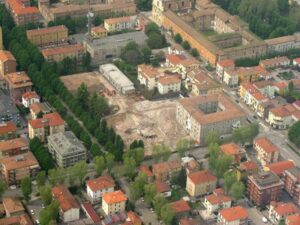
I would start from the former hospital site, right in the historic centre — a place that shows both the challenge of unused heritage and the opportunity to create affordable, mixed-use housing. It’s our main regeneration project in Fidenza, a medium-sized city in Emilia-Romagna. We want to transform it into a new mixed-use district combining affordable and social housing, cultural and community spaces, and green public areas. We’re developing it because the city faces a strong demand for accessible housing, especially among young people and workers from a vibrant local industrial district. The main condition is to make it financially sustainable while keeping a strong social purpose. Then I would walk through the eastern district, where new housing needs meet industrial growth; i would also show you the Jesuits’ College, home to the emerging Sigeric European Cultural Centre — a project that reconnects housing, culture, and education at the heart of the eastern district, reinforcing the idea that living well also means having access to knowledge, identity, and shared cultural spaces. And finally visit a beautiful local co-housing community that has been active for over 15 years, showing that affordability and community can really work together: the Ecosol co-housing community, a purpose-built building hosting 14 families, active for more than 15 years. It represents a living example of a different way of inhabiting: shared spaces, energy efficiency, and strong social ties, proving that affordability and quality can grow together.
2. What does “home” mean to you personally?
For me, home is not just a private space — it is a relationship with a neighbourhood. Home means being able to recognise yourself in the neighbourhood you live in, to feel safe but also involved, and to know that the place you inhabit will still be there for you tomorrow.
It is about stability, affordability, and dignity — but also about belonging and participation. This is why, in my work as a councilor, housing is never separated from public space, services, energy, and community life: a home truly exists only when it is part of a living urban ecosystem.
3. Can you describe your renovation or project in one sentence, as if explaining it to a neighbour? And your organisation?
We want to transform the former hospital into a new neighbourhood where heritage buildings become homes, services, and shared spaces again.
Our municipality acts as a facilitator and bridge, helping private owners, investors, all the stakeholders and the community align around a common long-term vision.
4. What does a “good renovation” feel like for the people who live there?
A good renovation feels natural and inclusive: people recognise the place, but they also feel it finally belongs to everyday life again.
It’s when residents feel proud of where they live — and not pushed out by change and “gentrification”. Innovation is central to our projects — not only in technical terms, but in how housing, energy, and the environment are treated as one system. Alongside new housing models, we place strong emphasis on the energy and environmental transition. Fidenza hosts a very active Renewable Energy Community (REC), which I currently chair, and we are integrating energy sharing, efficiency, and local renewables into our housing strategy. At the same time, we are completing the remediation of one of the most significant former industrial sites in Italy, turning an environmental legacy into a future opportunity.
All these actions are framed within a broader vision for the city, which we are shaping through our new General Urban Plan, designed to align housing affordability, climate goals, and long-term territorial resilience.
5. What’s one small thing that always makes you smile during a renovation project?
When a renovation turns scepticism into trust, and trust into cohesion, you know you’re not just rebuilding walls and buildings — you’re rebuilding the social contract, grounded in fairness, inclusion, and long-term public value
6. If you could take a couple of things you’ve learned and share it with another city, what would they be?
First: treat affordable housing as a shared European mission, not as isolated local projects — cities learn faster when they learn together. Second: design flexibility into policy and planning, so local authorities can adapt EU goals to real places, real people, and real markets, while keeping social inclusion and long-term public value at the core.
7. What would you like to see change in EU or national policy to make this work easier or faster?
We need more flexible and enabling frameworks at EU and national level for affordable and mixed-use housing, especially in medium-sized cities and heritage contexts.
Policies should support municipalities not only as regulators, but as active enablers and brokers, allowing phased development, hybrid uses, and innovative partnerships. Cities like Fidenza are growing steadily: we attract workers, young couples, and new residents, and we act as a reference point for a much wider economic district. Yet without timely and affordable housing solutions, this growth risks turning into socio-economic stagnation.
Housing policy, therefore, is not a marginal issue — it is a core lever for social cohesion, competitiveness, and long-term territorial resilience, fully aligned with European objectives.