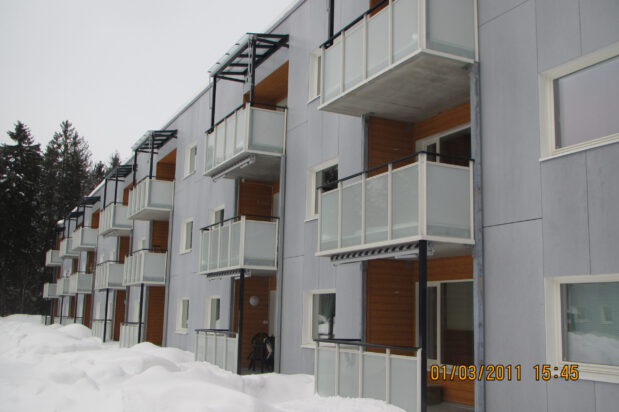
Myhrerenga
Location: Skedsmokorset, Oslo, Norway
What is innovative about this project?
- Project planning & management: Tackle renovation of multi-apartment blocks, including multi-ownership challenges.
- Project planning & management: Ensure cost-neutrality for residents after the renovation operation.
- Project planning & management: Financial model and financial feasibility.
A typical building renovation in Norway, as in most other countries, deals with modest energy measures. This can result in lost opportunities for decades. Myhrerenga is the first apartment house renovation in Norway which uses Passive House components to reduce energy consumption, guarantee thermal conform and quality indoor climate to the residents of Myhrerenga Housing Cooperative. The success of the project laid in its ability to keep what could be a costly renovation cost-effective and cost-neutral to its residents.
LOCAL PARTNERSHIP
- Company: Agathon Borgen AS (contractor)
- Municipality: Skedsmo
- Housing provider: Myhrerenga Housing Cooperative; USBL Housing Association
- Other: SINTEF; The Norwegian State Housing Bank; the Norwegian Energy Agency Enova; Arkitektskap AS (architects)
USBL Housing Association manages approximately 26.500 homes owned by 566 housing cooperatives. The Myhrerenga was suggested as pilot project for EKSBO, an open research project (2006-2009) contributing to increasing energy efficiency and the use of new renewable energy in the existing housing stock in Norway. The project was financed by the Research Council of Norway, Husbanken, Enova (Norwegian Energy Efficiency Body) and a number of partners from the industry. SINTEF Byggforsk was involved as specialist organisation regarding effective renovation measures to achieve high energy efficiency performance. SINTEF also informed on strategies to communicate the project, based on their experience in decision-making in a housing cooperative context. The Norwegian Housing Bank and Enova funded the renovation (financing package). Arkitektskap AS was chosen as designers of the buildings and the outdoor area.
KEY FACTS
- Year of construction: 1968-1970
- Renovation period: 2010-2011
- Area of intervention (m²): before: 11.000 m²
- Number of dwellings (before/after): 168
- Housing typology: multi-apartment buildings
- Housing tenure: cooperative housing,
- Number of residents: 300-500
- Shared facilities: recreational and green areas
FINANCIAL INFORMATION
- Funding sources: Norwegian Energy Agency Enova; The Norwegian State Housing Bank
- Total cost of renovation (€): 9,300,000€ (2011) (EUR 1 = NOK 8)
- Subsidies received (€): 800,000 € – Norwegian Energy Agency (Enova)
- Rent before and after renovation (€/month): overall average reduction of 40–50 €
- Energy bill (€/month): 60€ (after Passive-House renovation), 140€ (estimated after conventional renovation)
CONTEXT
Myhrerenga Housing Cooperative is situated in Skedsmokorset (Lillestrom municipality), a middle-income residential area surrounded by semi-detached houses bordering woodland. Myhrerenga consists of seven similar blocks, erected in 1968–1970, three storeys high with 24 apartments in each block. The site is representative of the Norwegian context, where nearly 80% of families own their dwelling, whereas 14% own their housing unit through a cooperative. Façades in need of renovation, together with complaints about drafts, cold floorboards, and inadequate air quality, as well as requests for larger balconies, made the cooperative board decide to initiate the renovation. The board of Myhrerenga took the initiative of renovating the complex, aware of the difficulties to get the minimum resident’s agreement. The Cooperative has an agreement with USBL Housing Association, who acted as the project manager and developer and mediated at the board meetings. Since the buildings were in need of a major renovation anyway, the Norwegian State Housing Bank in cooperation with SINTEF suggested an ambitious «Passive House renovation».
GOALS
- To realise a renovation project towards the Passive House standard by upgrading of the building infrastructure and design while increasing residents’ thermal comfort and indoor climate.
- Maintain the expected rent level of a traditional renovation, through reduced energy costs, grants and sound financing.
- Reduce the overall energy demand and use renewable energy sources.
INTERVENTIONS
- Installation of below-ground and blow-in insulation in the attic and cladding on exterior wall. Windows were also replaced (Passive House windows and «almost» Passive House doors), insulation on staircases and outer cellar walls was simplified, and installation of a ventilation system with a heat recovery of 79% was put in place.
- Addition of new and larger balconies and doorways.
- Renovation of the central energy system, and the oil- and electric boilers were replaced with three air-to-water heat pumps and a solar collector system, consisting of 44 vacuum solar collectors placed on the roof nearest to the boiler house to complement the heat pump system in the summer. The heat pump- and solar system cover for most of the heating and domestic hot water demand, but one of the electric boilers was kept to take the peak load the coldest periods.
- Organisation of workshops and information gatherings with members of Myhrerenga, USBL Housing Association, research partners (International Energy Agency and SINTEF); energy technician and architects, before and during renovation to address residents’ concerns, mostly around costs and financial advantages of the project.
IMPACT
The renovation of Myhrerenga showed Passive House retrofits are possible in a cold climate country such as Norway, and a high level of homeownership. After renovation, residents were satisfied with the indoor environment and temperature, even after experiencing the first winter. They were also proud of the new look of the building blocks, and happy with the extended balconies. Some residents were not happy with the placement and opening sides of windows in the kitchen and living room. This seems to be caused by lack of discussion with the users, and insufficient specification in the orders. As a result of the renovation, the market value of the flats was estimated to increase substantially.
The additional investment cost associated with the Passive-House energy (20.7 million NOK) were made compatible with lower monthly costs for residents (40–50 € lower) due to the grant received from Enova (800,000€); a lower interest rate from Norwegian Housing Bank (4,7%) compared with ordinary bank (5,7%); and reduced energy costs (based on an energy price of 0,1 €/kWh). In addition, this type of renovation led to tax reductions. The rent had previously been increased more than necessary according to existing payment obligations. As a consequence, the cooperative had built some equity for new investments and had established a rent level which made the additional increase less dramatic (approx. 20%).
ADVICE TO FUTURE ‘LIGHTHOUSE DISTRICTS’
- Examine all available options case by case. The Myhrerenga project demonstrated that building renovation based on Passive House standards is cost-effective when the building mass is in poor condition and a major renovation must be undertaken. Performing slight upgrades to the building stock or merely maintenance works can be financially unsound if seen in the long run and jeopardise the financial capacity to perform ambitious renovations in the future.
- Build up trust with the board and between the residents. When the residents were sufficiently informed about the conditions of renovation beyond energy needs – comfort, air quality and the payback period of the initial investment – their engagement and sense of ownership was increased which resulted in a successful project.
- Ensure the renovation works do not imply a significant increase in rents.
- Ensure adequate capacity is in place, i.e., the right people and enough resources to manage the renovation process.
- Ensure enough information is provided and residents are involved. An initial constraint placed by the need to have a consent majority of residents was addressed with added information and involvement of the residents over a period of 1-3 years. Also, the residents were given two options to renovate with similar costs, one traditional and one ambitious- (components of the Passive House), which made the buy-in easier.