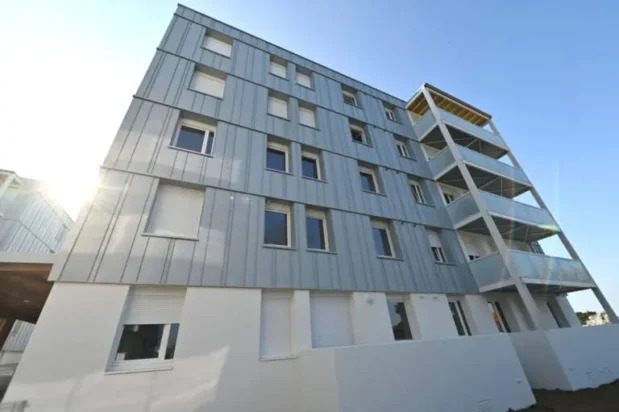
Morbihan Habitat – Major Social Housing District Renovation in Kerfréhour residence in Lanester (56) with reuse of material
14-12-2023Bretagne Sud Habitat has embarked on a major urban renewal project in the Kerfréhour and Châtaigneraie districts. 3 buildings were demolished (100 dwellings) and 7 were renovated (140 dwellings), with an average cost of €60 000 euros per dwelling. The performance objective of this refurbishment programme was to obtain a Nearly Zero renovation label, which requires primary energy consumption to be less than or equal to 80 kWhep/m²/year. This objective was achieved, as the average primary energy consumption for the project is now 52 kWhep/m²/year, representing a 54% improvement on the existing building. Other objectives included a participatory approach with tenants, improved accessibility, the re-use of demolition products and the use of bio-sourced materials.
The study phase was launched in May 2019 and lasted 20 months, with the worksite taking 14 months despite the presence of asbestos in the 3 buildings demolished (floors, walls and ceilings). The redevelopment of the 140 homes was completed in September 2022.
The works undertaken :
– Renovation and redevelopment of housing
- Demolition of blocks of flats to create new housing
- Creation of a Home for ageing people
- Demolition of a shopping center
- Creation of a Medical Health Center
- Public spaces have been redesigned to improve accessibility, and have been greened
Renovation of the façades :
The façades have benefited from thermal renovation of the entire envelope (thermal insulation, external joinery, lower floors, roofing) with the installation of balconies. External thermal insulation was carried out using rock wool under zinc cladding on the upper floors, while on the ground floor, the choice fell on low-carbon insulation using wood wool under plaster, which accounts for 20% of the external thermal insulation surface area. Zinc cladding is also a sustainable choice, as the material offers excellent resistance over time and is self-cleaning. Synthetic insulation solutions such as polystyrene or polyurethane have been ruled out, to improve the carbon footprint and limit the risk of fire.
Reuse of materials :
A re-use approach has been integrated into this project. This is a pilot operation carried out as part of the European Interreg FCRBE research programme, with the aim of recovering materials and equipment from the demolition of 40 homes. A survey of the building’s resources was carried out to estimate the quantity of materials available for reuse (preservation of use) and re-use (diversion of use with little transformation). As a result, all the external metal porches and ceiling portholes, 75% of the boilers, 30% of the internal doors and 20% of the washbasins were recovered and reused.